Sunday, February 20, 2022

Robert F. Smith Launching $1.8M Grant Program To Help HBCU Students


Robert F. Smith's organization, the Student Freedom Initiative recently announced via a press release their partnership with Prudential Financial who is providing $1.8 million in microgrants to HBCU students.

Read that press release below:

As resources are directed towards Historically Black Colleges and Universities (HBCUs) across America, there remains an ongoing crisis among HBCU students of failing to matriculate due to unforeseen, emergency expenses. According to a recent study by the Federal Reserve, 40% of Americans – predominantly Black and minority Americans – would have difficulty covering an emergency $400 expense, relying on borrowing the money from friends or family or incurring further credit card debt.

To provide this urgently needed aid, Student Freedom Initiative today announced catalytic support from Prudential Financial, with Prudential providing $1.8 million in microgrants to HBCU students in an effort to accelerate economic mobility and close the financial divide. Prudential will also provide paid internships and pro bono services to enable improved financial literacy for Historically Black Colleges and Universities (HBCU) families and students.

This grant from Prudential will support the launch of the Handling Everyday Life Problems for Students (HELPS) Program, a crucial service to address unexpected, one-time expenses disproportionately faced by Black students, furthering Student Freedom Initiative and Prudential’s shared commitment to close the racial wealth gap. Launching as a three-year pilot program with nine HBCUs, the HELPS Program supplements HBCU-provided resources and will be launched with the Spring 2022 academic year at participating institutions. Students who qualify will receive supplemental funds to address emergent financial issues that present a risk to the student’s ability to matriculate, including issues that may cause immediate risk to a student’s health, life, property, or environment, requiring immediate attention.

In recent conversations with HBCU presidents, many detailed the challenges their students face, particularly in this hybrid environment. One president recalled how one of their students was unable to fully participate on camera for class – a requirement – due to a damaged computer, adversely impacting the student’s grades.

Another president described always keeping petty cash in their office, at one time providing a student $300 to cover an unexpected expense. The student later told the president had it not been for that $300, it is likely they would not have graduated at all.

With the implementation of the HELPS program, students like these can now access critical microgrants to support their persistence to graduation.

Committed to a fully inclusive workforce within its own ranks, Prudential will also provide paid internships via the internX.org platform, which pairs highly qualified, rising sophomores through seniors across all majors with companies seeking diverse talent. There are over 220 companies, over 14,000 students, and 1,300+ Course Learning Management Systems on the internX.org platform. In addition, Prudential will collaborate with Student Freedom Initiative and the participating institutions to prepare and conduct age-appropriate, culturally sensitive, financial literacy education and training for students, in a format that is culturally sensitive and recognizes the current hybrid model employed by these institutions.

“Student Freedom Initiative applauds the leadership of Prudential Financial and their support for our shared mission of eliminating barriers of access for underserved communities,” said Robert F. Smith, Chairman of Student Freedom Initiative. “By enabling the launch of the HELPS Program, a vital component of our work to address the holistic needs of HBCU students and families, Prudential’s gift will provide long-needed and often overlooked aid and support persistence of those most vulnerable in our community.”

“At Prudential, we’ve spent decades working to close the financial divide, in part through partnerships that address systemic barriers to economic, social, and racial equity,” said Sarah Keh, vice president, Inclusive Solutions, at Prudential Financial. “As part of our multiprong strategy to support HBCUs, our partnership with Student Freedom Initiative will help us scale solutions so that more Black students will remain in college and ultimately graduate, putting them on a path to financial security.”

“Over 75% of students at HBCUs are considered low-income, relying on Pell Grants to meet their college expenses. However, for many of these students, these grants are not enough,” added Mark A. Brown, Executive Director of Student Freedom Initiative. “During recent onsite visits at multiple HBCUs, we learned from executive leadership and student focus groups that many of our students are unable to overcome financial challenges for expenses that are not directly related to the cost of college. These expenses, left unaddressed, can derail their college plans. In addition, most of these students lack the necessary financial literacy to make informed decisions, though they are asked to signed complex promissory notes that could indebt them well into their adult lives. Further, while some may have support from parents through costly Parent PLUS loans, many of these students have reported feeling personally responsible for any negative affects these loans had on their families. With additional financial support from sponsors, we can ensure that more HBCUs and eligible students will not be forced to choose between their education or their financial wellbeing if met with a hardship during the course of their studies.”

Students may begin taking advantage of Student Freedom Initiative’s HELPS Program starting in the Spring semester 2022. Visit HELPS Program to learn more.

About Student Freedom Initiative

A single purpose nonprofit organization, Student Freedom Initiative provides a catalyst for freedom in professional and life choices for students attending Minority Serving Institutions (“MSIs”) by increasing their social and economic mobility using a student centric, evidence based, holistic, and collaborative approach. Initially focused on Historically Black Colleges and Universities, Student Freedom Initiative enables mobility through four transformational components: (1) Income Contingent Alternative to Parent Plus and Private Loans, (2) Internships, (3) Tutoring/Mentorships/Other Services, and (4) Targeted HBCU Capacity Building. Student Freedom Initiative collaborates with community-based organizations, businesses, and governmental entities through public-private partnerships to make sustainable, systemic changes to support the entire HBCU ecosystem.

To date, Student Freedom Initiative has received generous contributions from our anchor donors Robert F. Smith, Fund II Foundation, and Cisco Systems, and many others who have provided financial and/or in-kind services. The program has also been acknowledged and supported by the Business Roundtable's Racial Equity & Justice Subcommittee on Education.

To learn more, visit www.StudentFreedomInitiative.org or find us on Twitter @StudentFreedom.

Saturday, February 19, 2022

Elena Myers Taylor is the most decorated African American Winter Olympian of all time

Olympic bobsledder Elana Meyers Taylor has made history by becoming the most decorated Black athlete in the Winter Olympics.

Meyers Taylor, 37, won bronze at Beijing 2022 on Saturday. The win also made her the most decorated female Olympic bobsledder. The title was previously held by Shani Davis who had four medals.

Meyers Taylor said she was a bit overwhelmed by the news.

"It’s so crazy to hear that stat and to know that I’m part of a legacy that’s bigger than me," she said, according to CNN. "Hopefully it just encourages more and more black athletes to come out to winter sports and not just black athletes, winter sports for everybody.

"We want everybody to come out regardless of the color of your skin. We want winter sports to be for everybody, regardless of race, regardless of socio-economic class," she continued. "I think the more diversity we have, the stronger our sport can be. So hopefully this is just the start of more and more people coming out and trying winter sports."

This is the fourth Olympic Games for the athlete. Meyers Taylor, who began bobsledding in 2007, also competed in the Vancouver 2010, Sochi 2014, and PyeongChang 2018 games. In total, she’s won three silver and two bronze.

[SOURCE: MSN]

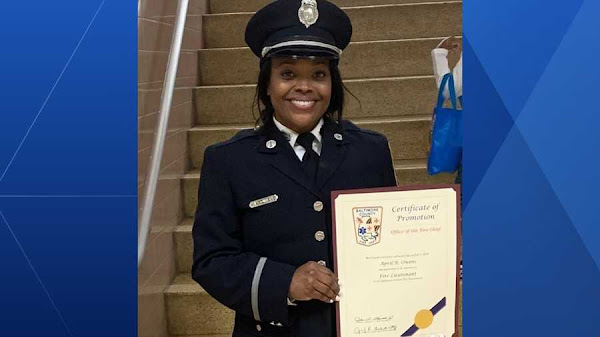
April Owens: First African American woman promoted to fire captain in Baltimore County

April Owens became Baltimore County's first African American woman to be promoted to the rank of fire captain.

The Baltimore County Fire Department said the promotion took place Wednesday and is effective Feb. 26.

Owens said Black History Month is a time to "remember the past, appreciate the present and find motivation for change in the Fire Service."

She said she was inspired by her brother, a paramedic/firefighter with the Montgomery County Fire and Rescue Service. She served as a cadet with Baltimore City Fire Department before joining the Baltimore County Fire Department.

Dr. Susan M. Collins named next President and CEO The Federal Reserve Bank of Boston

The Federal Reserve Bank of Boston announced that Dr. Susan M. Collins will be its next president, CEO, and participant in national monetary policymaking on the Federal Open Market Committee.

Collins currently is provost and executive vice president for academic affairs at the University of Michigan – a role the university asked her to take on in 2020. She is also the Edward M. Gramlich Collegiate Professor of Public Policy and Professor of Economics.

As provost, Collins is the University of Michigan's chief academic and budget officer, responsible for overseeing all academic programming and budget planning and aligning administrative and support functions to advance the university's mission. Previously, she was a professor – and for a decade was the Joan and Sanford Weill Dean – at the university's Gerald R. Ford School of Public Policy.

Collins is an international macroeconomist with a lifelong interest in policy and its impact on living standards. She has published widely and served as a provost, dean, professor, research scholar, and board member at a variety of organizations.

The announcement follows a rigorous search, selection by the eligible (non-banker) members of the Bank's Board of Directors, and approval by the Washington-based Board of Governors of the Federal Reserve System.

"After an intensive search, we are thrilled to appoint this exceptionally well-qualified person to be the Bank's president and a key leader in the Federal Reserve System," said Dr. Christina Paxson, president of Brown University and chair of the Bank's Board of Directors, who also led the Presidential Search Committee.

"Dr. Collins brings the technical expertise and insight to contribute to policymaking and the leadership ability to head the organization," Paxson said. "She is deeply committed to serving the public, engaging with constituents, and advancing economic stability, opportunity, and prosperity for the region and nation through the work of the central bank. Susan has also advanced diversity, equity, and inclusion through her work with the American Economic Association, the Ford School, and the University of Michigan."

"It is an honor and an inspiration to serve as the Boston Fed's next president," Collins said. "Throughout my career, I have been driven by a commitment to leveraging research, education, and public service to improve lives. I look forward to helping the Bank and System pursue the Fed's dual mandate from Congress – achieving price stability and maximum employment."

"I am also inspired by the portfolio of important and innovative work underway at the Boston Fed," Collins said. "I am delighted with the opportunity to lead such a dynamic organization, engage with its talented staff, and work with its constituents – to understand their economic challenges and help explain the work of the Fed in the economy. It will also be a pleasure to return to Greater Boston and New England."

Collins spent many years in the Boston area while earning her undergraduate degree at Harvard University (summa cum laude), earning her Ph.D. at the Massachusetts Institute of Technology, and while serving as an assistant and then associate professor of economics at Harvard. She also worked in Washington in roles including senior staff economist at the President's Council of Economic Advisers, professor at Georgetown University, senior fellow in economic studies at the Brookings Institution, and visiting scholar at the International Monetary Fund.

"We are very pleased that Dr. Collins will be leading our organization," said Kenneth Montgomery, interim president and CEO of the Boston Fed and the Bank's first vice president. "She is a leader with exceptional background and perspective. She also has a deep understanding of the Federal Reserve System's inner workings, having served for nine years as a director at the Chicago Reserve Bank. I am excited to work with Susan here in Boston, and I know she will help us build on our Bank's distinctive contributions."

Collins will assume the Bank's presidency on July 1, following the completion of the academic year at the University of Michigan. Montgomery will remain the Bank's interim president until then and will continue as first vice president and chief operating officer. He assumed the interim president role last fall when former president Eric Rosengren retired following 35 years of service to the Bank (14 as president). Montgomery will also continue leading the Federal Reserve System's FedNowSM Service, which will support instant payments for businesses and individuals.

In addition to positions held in the Boston area, Washington, and Michigan, Collins has a broad range of professional affiliations and engagements. She is currently a member of the board (and executive committee) of the Cambridge, Massachusetts, based National Bureau of Economic Research, where she has been involved in research since 1984. She is a member of the board of the Peterson Institute for International Economics and a nonresident senior fellow at the Brookings Institution. She will step down from these positions before taking office. She is also a member of the Council on Foreign Relations and the Aspen Economic Strategy Group.

Collins has served multiple times as a moderator at the Jackson Hole symposium hosted by the Kansas City Reserve Bank. And from 2006 to 2009, she served as an elected member of the American Economic Association's executive committee. Earlier, she had been a member and then chair of the American Economic Association's Committee on the Status of Minority Groups in the Economics Profession. More details on her professional affiliations can be found in her biography.

Collins grew up in New York City to Jamaican parents and became a U.S. citizen in 1997. She is married to Dr. Donald R. Vereen, Jr., M.D., M.P.H., who trained at Harvard and Tufts Universities and at Boston-area medical institutions. They have two adult children.

Her published research has focused on the determinants of economic growth, exchange rate regimes and economic performance, the implications of global integration for U.S. labor markets, persistent macroeconomic imbalances, and countries' economic transformations.

Given the established rotation of Reserve Banks, in 2022 Collins will be a voting member of the Federal Open Market Committee after taking office. As president, she will oversee the Bank's responsibilities in monitoring local economic conditions to aid in the formulation of monetary policy, engaging in outreach to promote economic growth and community revitalization, supervising banks and bank holding companies, and providing financial services to facilitate banking operations.

Collins will fulfill the remainder of the current five-year term that commenced on March 1, 2021, and ends on February 28, 2026 – a juncture at which she, like all Reserve Bank presidents, will be considered for reappointment via a rigorous and comprehensive process overseen by the Board of Governors.

Reserve Bank presidents are subject to mandatory retirement considerations. Presidents initially appointed after age 55 are eligible to serve up to 10 years in office.

Friday, February 18, 2022

Chicago school that changed its name to honor Harriet Tubman celebrates name change

Chicago Public Schools leaders and elected officials unveiled new signage at Harriet Tubman Elementary School on Monday as the school continues to distance itself from its prior namesake, the racist scientist Louis Agassiz.