Sunday, October 11, 2015

Thousands pack D.C. for 20th anniversary of Million Man March

Under clear skies and amid metal detectors, barriers and moderate police presence, thousands of people crowded onto the National Mall on Saturday to hear messages bemoaning cases of alleged police misconduct and to observe the 20th anniversary of the Million Man March. Watch video of attendess of the event below:

Friday, October 09, 2015

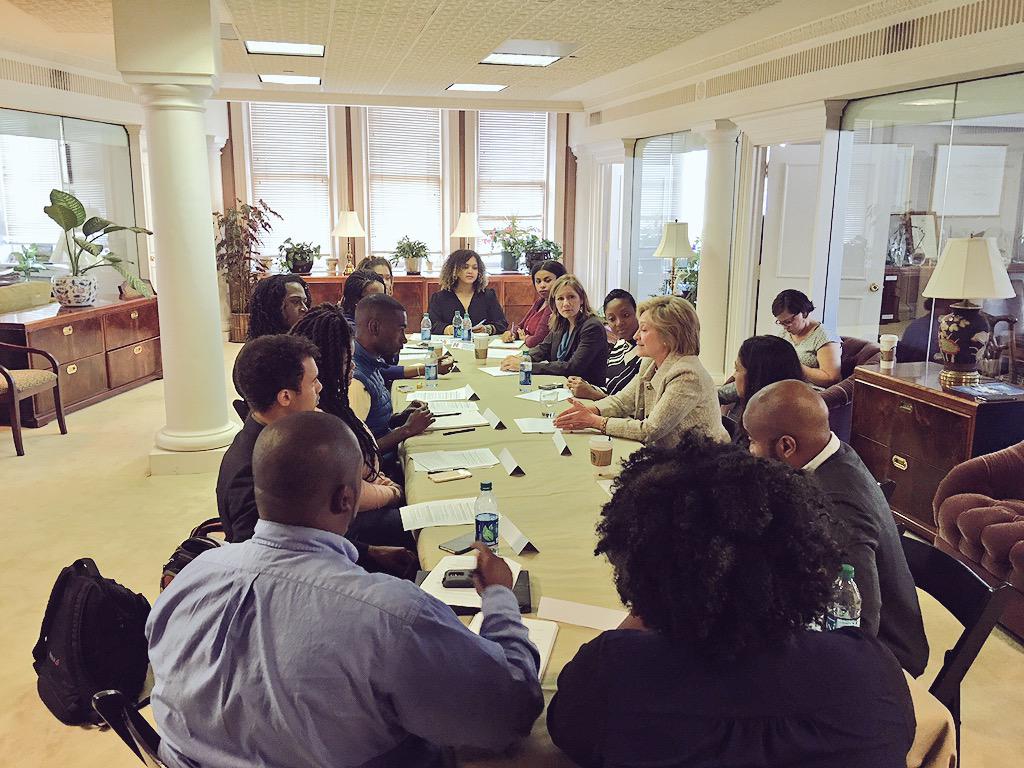
Black Lives Matter Activists Say Meeting With Hillary Clinton Went Well

After Hillary Rodham Clinton wrapped up a meeting with Black Lives Matter activists in Washington, initial reports signaled that it had been a productive session.

DeRay McKesson, the leader of the group that is pushing to end police brutality against black people, tweeted out some details after the 90-minute gathering and said that they had pushed Mrs. Clinton to use less “coded” language when talking about black issues and to “de-center” the police as the key to making communities safer. He said that the Democratic presidential candidate was clear in her commitment against private prisons.

“In the end, I think she heard us,” Mr. McKesson said.

Aurielle Marie, another member of Black Lives Matter who was at the meeting, said Mrs. Clinton listened closely but did not offer specific proposals for addressing “anti-blackness” in America. Ms. Marie said that she was impressed with Mrs. Clinton’s openness, but also expressed concern about a lack of urgency among all of the presidential candidates.

“We are past the point where we need to just sit around and have conversations,” Ms. Marie told CNN. “The matter is urgent.”

The group is expecting to hear more details from Mrs. Clinton about her platform for overhauling the criminal justice system in the coming weeks.

[SOURCE]

Wednesday, October 07, 2015

Civilian review board finds excessive force in James Blake takedown

The Civilian Complaint Review Board has substantiated the charge of excessive force against Officer James Frascatore, who took James Blake to the ground last month, and recommended departmental charges that could lead to his suspension or dismissal.

Police Commissioner William Bratton will make the final determination, following an internal departmental trial.

James Blake released the following statement:

"I want to express my appreciation to the Civilian Complaint Review Board for their quick and thorough review of the incident during which I was attacked on September 9, 2015. I learned today that the CCRB has substantiated the Complaint, filed on my behalf by my attorney Kevin Marino, against James Frascatore (for excessive force), and Daniel Herzog (for abuse of authority). It is my understanding that these officers now face an administrative trial for their roles in the respective offenses. I have complete respect for the principle of due process and appreciate the efforts of the CCRB to advance this investigation."

[SOURCE]

Monday, October 05, 2015

Alarming Facts About African American Women and Breast Cancer

Did you know breast cancer is the second leading cause of cancer death among black women?

Although breast cancer is diagnosed more often for white women, African American women are more likely to die of breast cancer, according to a recent study by the Journal of Clinical Oncology. Specifically, in women under 45, breast cancer is more common in African American women than white women.

Here are a few more facts about breast cancer and the action you can take today:

In 2015 alone, an estimated 231,840 new cases of invasive breast cancer are expected to be diagnosed, along with 60,290 new cases of non-invasive breast cancer, according to SusanGKomen.org. Many studies indicate these decreases are due to the result of earlier detection through screening, treatment advancements, and increased awareness.

The breast cancer death rate for women aged 45–64 years was 60% higher for black women than white women, according to the CDC National Vital Statistics System.

The median age at diagnosis in African American women is 54 years, compared with a median age of 58 years in white women.

Read more: Alarming Facts About African American Women and Breast Cancer

Saturday, October 03, 2015

Why black teachers are leaving urban schools

While the percentage of minority teachers has risen in the US, the number of black teachers has declined between 2002 and 20012 in nine cities, according to a recent study by the Albert Shanker Institute.

What does this mean not only for the communities in which these schools exist, but for the nation as a whole?

“Diversity is a key component to equality and opportunity,” Randi Weingarten, president of the American Federation of Teachers, told the Washington Post. “Where there’s a diverse teaching workforce, all kids thrive. That’s why we note with alarm the sharp decline in the population of black teachers in our cities.”

There are several factors which may be behind this decline. The first is low pay for teachers. According to a study by Young Invincibles, an advocacy group, the average starting salary for a teacher is $34,575 – or about $6,000 less than the average starting salary of 28 professions.

The second is the recurring emphasis that education policy tends to place on test scores. This rigidity, argues Nekita Lamour, a Haitian-American and tenured educator, disincentivises black and Hispanic educators from participating in the system: they are not being encouraged to teach their fellow man, but to the test, instead.

The Shanker Institute’s study found that over a ten-year period, from 2002 to 2012 (a period marked by an explosion in the development of charter schools, and an accompanying dialogue about education reform), the population of black teachers declined by as much as 62 percent in the cities studied (although in the case of New Orleans, many black teachers were fired).

“Minority teachers quit because of working conditions in their schools,” Richard Ingersoll, an expert who teaches at the University of Pennsylvania, also told the Washington Post. “In surveys, those teachers cite lack of autonomy and input into school decisions [in large urban schools].”

Read more: Why black teachers are leaving urban schools