Saturday, May 05, 2018

Minority Kids Underrepresented in Autism Diagnoses


In education circles, it is widely accepted that minorities are overrepresented in special education. New research from the University of Kansas has found, in terms of autism, minorities are widely underrepresented in special education. The underrepresentation varies widely from state to state and shows that students from all backgrounds are not being identified accurately, resulting in many students, especially those from minority backgrounds, not receiving services that are crucial to their education.
Jason Travers, associate professor of special education at KU, led a study that analyzed autism identification rates for every state. Travers then compared the percentage of minority students with autism to the percentage of white students with autism in each state and compared rates for each group to the rate for white students with autism in California. The analyses looked at data from 2014, which was three years after federal regulations changed from five racial categories to seven. It was also the most current year for data analyzed by the Centers for Disease Control on the prevalence of autism. Travers’ research had previously shown underrepresentation of minorities in autism, but the change warranted a renewed look.
“A considerable change in demographic reporting happened at the federal all the way down to the local level,” Travers said. “So individual schools had to change their reports and send them to the state, who then sent them to the federal government. So, for several years we’ve had an incomplete picture of autism identification rates.”
The change allowed schools to report students, including those with autism, as belonging to “two or more races” for the first time, and also established two separate categories for Pacific Islander and Asian students who previously were reported as one group. The report, co-authored with Michael Krezmien of the University of Massachusetts-Amherst, was published in the journal Exceptional Children.
The data showed dramatic underrepresentation of minority students with autism in the majority of states, especially for African-American and Hispanic students. Forty states underidentified African-American students with autism when compared to white students in the same state, and 43 states underidentified Hispanic students. When the rate for each minority was compared to the rate for white students with autism in California, the data showed nearly every state underidentified minority students with autism.
Not one state had higher percentages of students from those minority groups identified at higher rates than whites, and no state had African-American or Hispanic students listed at the same percentage of white students with autism in California.
“We suspected that, although the U.S. has a similar amount of Hispanic and African-American people, children with autism in both groups would be underrepresented compared to white students. We also didn’t know what the rates would be for students identified as being two or more races, Pacific Islander and Asian students due to these being new federal reporting categories,” Travers said.
California was used as a comparison for the other states as it is both the largest state by population and widely considered to have outstanding infrastructure for identifying and serving students with autism. The identification rate in California also was similar to the prevalence rate recently reported by the CDC. As the largest state, it is also the state least vulnerable to statistical fluctuation in data, Travers said.
While underrepresentation of minority students with autism was common, there was wide variance from state to state. For example, in Kansas, African-American students were overrepresented. Iowa was the only other state where that was also the case. No states overidentified Hispanic students, and 42 states underidentified them.
“Almost every state in the nation underidentified African-Americans. We’re not sure why that happened, but it did,” Travers said. “Another notable finding about Kansas is Hispanic students continued to be underidentified.”
Students of two or more races were proportionately identified in the majority of states, though a handful showed both under and overidentification. Forty-six of 49 states, including the District of Columbia, had a lower percentage of white students identified than California. No states identified Asian students with autism at the same percentage as white students in California, the comparison group. For its part, California significantly underidentified every minority group when compared with their white peers with autism. Numerous other fluctuations in representation were found in the data as well.
The wide variance of representation shows a number of factors at play. States are identifying minority students with autism in ways different from white students, but also in ways different from those in California, Travers said.
“Some of that just may be statistics, but when you see almost all states identify children with autism at rates that are about or less than half of the rate for white kids in California, that seems pretty concerning,” Travers said. “Fundamentally, that means there are kids with autism who are not being identified, and therefore probably aren’t receiving the kinds of services we know can help. But there are also specific groups of minority children who are being identified at rates significantly lower than their white peers.”
The findings counter the prevailing notion in special education that minority students are overrepresented in special education because the system is being used as a tool of oppression. Instead, it could mean school officials are not identifying minority students with autism due to longstanding concerns about placing too many minority students in special education, at least in terms of autism, Travers said. Worse yet, the problem appears to be nationwide. If the data showed underrepresentation in only a few states or in one geographic region it could reasonably be explained as caused by that states’ policies or regional factors. Instead, Travers said, the findings suggest inaccurate autism identification is a more important problem than overrepresentation in special education, and that more must be done to ensure equitable access to specialized treatment. 
White students and families traditionally have more access to autism diagnoses and interventions, which can be expensive, Travers said. However, he doesn’t believe white students are overrepresented in the autism category. Instead, Travers suspects well-intentioned school leaders may be inadvertently denying minority students an autism eligibility due to concerns about exacerbating the widely perceived problem of minority overrepresentation. Travers hopes to study whether students are being accurately identified within their states in future research. He also hopes to determine if certain factors can more accurately predict autism identification by using a more sophisticated analysis of regional, school district, school and student-level factors.
For now, the data shows that underidentification of minority students with autism is happening across the country and that a better understanding of accurate identification is needed.
“These trends are prevalent across the country,” Travers said. “I think the focus on overrepresentation of minority students in special education overlooks the more important issue of accurate identification. The field should focus on ensuring accurate identification of minority students with disabilities, including those who need autism-specific services.”

[SOURCE: University of Kansas]


Congressional Black Caucus Urges the NCAA to Consider Reforming its Operating Model


On April 30, 2018 the Congressional Black Caucus (CBC), led by CBC Chairman Cedric L. Richmond (D-LA-02), sent a letter to the National Collegiate Athletic Association, urging the organization to consider reforming its operating model since its current “state of play…may fail to properly serve a large component of the NCAA’s student-athletes.” 

The letter follows Chairman Richmond’s launch last month of the CBC NCAA Task Force and a staff-level meeting during the same month between the CBC and the NCAA. In the coming weeks, the CBC will bring experts to Capitol Hill to further explore a number of issues addressed in the letter, including whether student-athletes are truly given an opportunity to get an education, whether the NCAA is a monopoly, and whether student-athletes should benefit from a portion of the revenue they help generate. 
In the letter, Chairman Richmond wrote, “The NCAA’s operating model has become a liability for the organization, its student-athletes, coaches, member institutions, alumni, and other important stakeholders. The model has invited serious litigation, under-the-table payments, questionable recruiting practices, and now a criminal probe by the Federal Bureau of Investigation. Our initial research has uncovered a number of items that we want to discuss with you. There are numerous issues that need further exploration by policymakers and by the public at large.” 
Secretary Condoleezza Rice, the Chair of the Commission on College Basketball, and Bill Hancock, the Executive Director of the College Football Playoff, were copied on the letter.

Full text of the letter is attached, online, and below. 
April 30, 2018
Mark Emmert
President
The National Collegiate Athletic Association
700 W. Washington Street
P.O. Box 6222
Indianapolis, Indiana 46206-6222
Dear Mr. Emmert:
On behalf of the Congressional Black Caucus (CBC) and its NCAA Task Force, I write you today to urge you and the member institutions that you represent to seriously consider whether reforms to the operating model of the National Collegiate Athletic Association (NCAA) are needed. We are fans of college athletics and appreciate the competitive spirit and accomplishments of America’s student-athletes. That being said, the current state of play in the NCAA may fail to properly serve a large component of the NCAA’s student-athletes. We are encouraged that the Rice Commission has issued a series of important recommendations that, if adopted, could positively alter the current state of play. Given that the NCAA and its member institutions are now reviewing the report and its ideas for reform, the CBC views this as an opportune time to reflect on the fairness of the current approach. 
Now that you have crowned new national champions in college basketball, it is imperative that you and your members consider the talents and labors that made these occasions possible. College basketball players and their achievements provide significant revenues for the NCAA and its members. If you add the revenues driven by the efforts of NCAA college football players, these two cohorts of student-athletes produce the overwhelming majority of college athletics-related revenue. Under this arrangement, these athletes also drive the revenues that pay for massive coaching salaries and for high-value investments in athletic facilities and playing fields. It is not an embellishment to say that these athletes drive the economics of the NCAA itself. 
The NCAA’s operating model has become a liability for the organization, its student-athletes, coaches, member institutions, alumni, and other important stakeholders. The model has invited serious litigation, under-the-table payments, questionable recruiting practices, and now a criminal probe by the Federal Bureau of Investigation. Our initial research has uncovered a number of items that we want to discuss with you. There are numerous issues that need further exploration by policymakers and by the public at large. 
Last month, the CBC formed an NCAA Task Force to study the NCAA’s operating model in order to determine whether policies are needed to ensure fairness in the relationship between student-athletes and the NCAA’s member institutions, including the economic well-being of the student-athletes. We will be performing extensive research, engaging in conversations, and bringing experts to Capitol Hill to explore these topics in further detail. We welcome your participation in a dialogue about the NCAA’s operating model, including your views on its benefits and shortcomings. We invite you and other important stakeholders to engage us in frank conversation in furtherance of our ultimate goal: thoughtful conclusions that we hope can bring about meaningful reforms if significant shortcomings are discovered.
We encourage you to engage us in a transparent exploration as we ask pertinent questions, including, but not limited to, the following: 
1. Does the NCAA’s emphasis on “amateurism” promote student-athletes’ best economic, mental, physical and educational well-being?

2. Is the NCAA’s current operating model promoting economic and racial inequality in the United States of America?

3. Does the NCAA apply similar penalties for similar infractions across all members, including incidents at Historically Black Colleges and Universities?

4. Does the NCAA’s current operating model promote anticompetitive effects in the college athletics marketplace?

5. Does the current length of scholarships for student-athletes maximize learning opportunities for student-athletes?

6. Is the NCAA exercising monopolistic market power or creating a monopsony effect in the market for college football and basketball players?

7. Should the NCAA allow its student-athletes to benefit from a portion of the significant revenue that they help generate?

8. Does the NCAA offer sufficient opportunities for its student-athletes to support themselves economically outside of their role as student-athletes?

9. Does the NCAA’s current distribution of revenue add value to the delivery of educational services for a high percentage of member institutions?

10. Does the NCAA audit or monitor revenue distributions to member institutions to ensure that they are being utilized for their intended purposes?

11. Do university athletic departments operate with sufficient oversight and accountability?

12. Does the NCAA have a responsibility to its student-athletes after their time as an athlete concludes?

13. How might changes to the NCAA’s operating model affect the ability of member institutions to finance NCAA sports programs that fail to generate sufficient revenue?

These are several of the many questions we will be asking relevant stakeholders in the weeks and months to come. We look forward to a dialogue with the NCAA and its leadership and invite you to come and meet with the CBC’s NCAA Task Force for an introductory conversation. We look forward to working with you to ensure that America’s student-athletes are well protected and provided for. 
Sincerely,
Cedric L. Richmond
CC: Secretary Condoleezza Rice, Chair, Commission on College Basketball Bill Hancock, Executive Director, College Football Playoff

Friday, May 04, 2018

St. Jude Receives $1Million Sickle Cell Grant

Dr. Glenda Newell-Harris, national president of The Links Foundation Inc. and The Links Inc. tours St. Jude Children's Research Hospital Thursday, May 3. The Links awarded a $1 million grant to St. Jude for sickle cell disease initiatives.


The Links Foundation, one of the nation’s oldest and largest African-American women’s volunteer service organizations, awarded a $1 million Legacy Grant to St. Jude Children’s Research Hospital Thursday with a goal of jumpstarting three critical sickle cell disease initiatives.

St. Jude has researched and treated children with sickle cell disease since opening in 1962, and today touts one of the largest programs taking care of sickle cell patients, with more than 900 children from across the region. The disease is the most commonly inherited blood disorder in the United States, affecting about 100,000 Americans. It more commonly manifests in people of African descent; Hispanics; and people of Middle Eastern, Asian, Indian and Mediterranean descent.

“We have made great progress,” said St. Jude president and CEO Dr. James R. Downing. “These children now are making it through childhood and into adulthood. Back when I was in medical school, most of them died before the age of 5. Their pain crises are less, and we’re able to prevent many of the major complications – much fewer strokes, much fewer renal failures, much fewer problems with their vision.”

The average life span today for children diagnosed with sickle cell disease is 45 years old.
In addition to eventually finding a cure, Downing hopes to see a future health care system that is more receptive to taking care of sickle cell patients once they leave St. Jude.

The executive board of The Links Foundation Inc., the philanthropic arm for The Links Inc., visited St. Jude ’s campus Thursday for the grant award.

“It’s wonderful to hear Dr. Downing say that he wants to be able to do more so that the average life expectancy can be just like everyone else,” said Dr. Glenda Newell-Harris, national president of The Links Foundation and The Links. “And it’s wonderful to be a part of an organization that wants to be a part of that revolutionary work that’s going to need to get done.”

The grant will support expansion of three St. Jude clinical efforts – studies designed to increase knowledge of cognitive deficits in children with sickle cell disease; development of a community health worker education program to counsel parents of infants with sickle cell disease in Nigeria; and an age-appropriate mobile app to help patients develop adequate self-care and disease literacy.

Read more: St. Jude Receives $1M Sickle Cell Grant.


Thursday, May 03, 2018

Auntie Maxine on Kanye: 'Perhaps sometimes he needs some assistance'

Outspoken Trump critic Rep. Maxine Waters (D-Los Angeles) weighed in on Kanye West's latest string of hot takes this week at a meeting of the Congressional Black Caucus. Waters praised the rapper for his contributions to the African-American community while also saying he sometimes "talks out of turn."

"Kanye West is a very creative young man who has presented some of the most revolutionary material in the African-American community," said Waters, who is among Trump's most vocal critics in Congress and has repeatedly called for the president to be impeached.

"But we also think that sometimes Kanye West talks out of turn and perhaps sometimes he needs some assistance in helping him to formulate some of his thoughts," she continued.

"We don’t think that he actually means to do harm, but we’re not sure he really understands the impact of what he’s saying, at the time that he’s saying it and how that weighs on, particularly the African-American community — and for young people in general," she added. "And I think maybe he should think twice about politics, and maybe not have so much to say."

[SOURCE: SFGATE]

Wednesday, May 02, 2018

Oregon Supreme Court gets first African-American justice

Adrienne Nelson made history this year, becoming the first African-American to be appointed to the Oregon Supreme Court in its 158-year history.

Nelson relocated to Oregon after graduating from the University of Texas School of Law in 1993 to be closer to family. She practiced law in Portland for several years before becoming a Multnomah County circuit judge in 2006. Nelson was appointed to Oregon’s highest court by Gov. Kate Brown on Jan. 2.

As she transitions to her new role, Justice Nelson wants to continue to address issues that are important to all Oregonians. She says she believes the most important ones are those that people don’t feel entirely comfortable talking about.

“There are so many issues that are going on in our society right now, and I would say that the biggest issue isn’t a legal issue,” Nelson says. “Rather, I believe civility and the ability to have conversations around hard topics is most critical for our country.”

The access-to-justice gap is another critical issue for Justice Nelson. She has held “listening sessions” at various community locations, allowing residents to share their experiences and concerns about the justice system.

“The goal was twofold,” Nelson explains. “It was to acknowledge that there was a gap between the perception of justice for people who came before us and my colleagues, as well as to figure out—once we identify that—where do we go from there to educate each other.”

Nelson believes she owes her success in the legal field to the inspiration she finds in people from all walks of life. And she says she hopes to continue to uphold the law as an equalizer that gives voice to people and issues that otherwise may not have support.

“People won’t always remember what you said or what you did, but they’ll remember how you made them feel, and I think that’s very important and something I try to live by,” Nelson says.

[SOURCE: ABA JOURNAL]

Tuesday, May 01, 2018

Congressional Black Caucus pushes for diversity during Silicon Valley Trip

Members of the Congressional Black Caucus are visiting Silicon Valley to push the tech industry to improve diversity.

The visit is part of the group's Tech 2020 initiative, which calls on companies to boost the numbers of African-Americans they employ.

Rep. Barbara Lee (D-Calif.), whose Oakland district borders the country's tech hub, expressed frustration with the industry's efforts.

“Silicon Valley's economy is booming but we still don’t have the parity and equity in terms of racial inclusion,” Lee told The Hill on Monday. “The lack of understanding of why racial equity is important is mind-boggling to me.”

Lee declined to identify the companies she was referring to.

She has been joined by other Black Caucus members, including Reps. Gregory Meeks (D-N.Y.), G.K Butterfield (D-N.C.) and Maxine Waters (D-Calif.), on the trip.

The lawmakers have met with Apple and PayPal and on Tuesday will meet with representatives from other companies including Facebook, Twitter and Airbnb.

Lee said that lack of diversity is hurting companies.

“I think from a company perspective, it helps with their growth, it’s economically beneficial to have a diversity of perspectives,” she said.

“We have also moral obligation to make sure there is an equality of opportunity for everyone.”

Read more: Black lawmakers press companies on diversity during Silicon Valley trip

High School football coach: I'm being forced out for having too many black players on team

Camden Catholic High School (NJ) football coach Nick Strom says he thinks officials are trying to force him out of his job because he has too many black players on his team.

The stunning allegation comes after school President Mary Whipkey and Principal Heather Crisci told him Friday afternoon that his contract as a history teacher would not be renewed for next year. The officials also asked Strom to resign from his posts as head football and golf coach.

Camden Catholic officials deny the allegations.

“I think this is from me not conforming with their viewpoints on what they want the student body and the football team to look like,” Strom alleged. “I’ve tried to build this program into one that’s based on kids being of ability, high character and high grades.

“From day one, the administration told me they did not approve of the ratio of black to white students.”

Strom estimated the topic of race came up “10 to 20 times” with Whipkey since he was hired as football coach in 2013.

“When I’d have a list of potential freshmen, the first question I’d be asked is if they were white or black,” he said. “I was confused about why the question was, ‘How can we get more white players in the program or on the field?’”

About half of the team's players are minorities, Strom said.

The embattled coach and teacher said there also were occasions when he was asked whether a student came from a single- or double-parent household.

“I always felt like I could be above it,” said Strom, who’s lost only two games in South Jersey over four years. “I don’t think as coaches we get into that. You’re trying to improve your team and trying to help kids be a part of society to make a difference in their lives.”

Another teacher controversy: Students support ousted Cherry Hill East teacher.

On Monday morning, Strom told school officials he won't resign, and will remain in his coaching roles until told otherwise.

Since Strom became coach, Camden Catholic is 34-6, with a 34-2 record against South Jersey teams.

Read more: Camden Catholic football coach Nick Strom fired; racism alleged

Monday, April 30, 2018

James Shaw Jr. honored by Nashville Predators

Although the current President of the United States could apparently care less about the heroic actions of an African American hero, the Nashville Predators took time to recognize and honor the bravery of James Shaw Jr. before Sunday's National Hockey League Game 2 against the Winnipeg Jets.

From CBS Sports:

Last week, Shaw helped bring a deadly shooting at a Nashville Waffle House to an end when he was able to wrestle the gun away from the shooter. Four people died in the shooting, but police said that if it weren't for Shaw's actions -- he grabbed the hot barrel of the shooter's AR-15 and took it away -- the bloodshed could have been much more severe.

On Sunday night at Bridgestone Arena, Shaw was in attendance and received a hero's welcome. He participated in some pregame festivities outside the arena, including hammering the "Smash Car," which has become a "Smash Plane" for this series against the Jets.

Shaw was seen in a shirt that read "Spread Love" in the style of Waffle House lettering prior to the game, but inside the building he was presented with a customized jersey by Predators coach Peter Laviolette. That jersey had Shaw's name on the back, and a captain's 'C' on the front.

During the game, Shaw was recognized and welcomed with a standing ovation by the home crowd. Multiple first responders who assisted in the aftermath of the tragedy also received a similar welcome.

[SOURCE: CBSSPORTS]

Sunday, April 29, 2018

Althea Gibson to be honored with a statue at U.S. Open Site

The United States Tennis Association has announced that Althea Gibson, the first African American tennis player to win a Grand Slam singles title, will be memorialized with a statue in her honor on the grounds where the U.S. Open is played.

Gibson, an inductee into the International Tennis Hall of Fame in 1971 who died in 2003, won the 1956 French Open to make history and the next year she won the women's singles titles at Wimbledon and the U.S. Nationals, the precursor to the U.S. Open. She repeated the Wimbledon-U.S. double in 1958. Overall, she won a combined 11 Grand Slam titles in singles, doubles and mixed doubles during her illustrious career.

“It’s simple. She’s the Jackie Robinson of tennis; she deserves it,” USTA chair and president Katrina Adams said in a statement. “By breaking the color barrier, she made it possible for every person of color after her to have a chance to achieve their goals in the sport.”

The Gibson statue will be the second to commemorate a groundbreaking tennis icon and the third to honor an American tennis legend at the home of the U.S. Open in Flushing, N.Y., joining Arthur Ashe, whose statue was unveiled in 2000 and anchors the USTA Billie Jean King National Tennis Center, and King, for whom the tennis center was renamed in 2006.

“Althea Gibson is an American treasure and one of my most important heroes, and I am thrilled she will finally be honored at the National Tennis Center. … Our sport owes a great deal to Althea,” King said.

[SOURCE: Sporting News]

Saturday, April 28, 2018

Joy Reid denies hateful blog posts, apologizes for old tweets

MSNBC anchor Joy Reid used her appearance Saturday on the network to deny making hateful blog post on her former blog, while also apologizing for tweets which she admits were wrong and insensitive.

Temple University rescinds Cosby's honorary degree

Temple University, where Bill Cosby long served as a leading public face and key fundraiser, said Friday it will rescind the honorary doctorate it awarded to the comedian in 1991 because he was convicted of sexually assaulting a former employee.

The Philadelphia university said its board of trustees accepted a recommendation Friday to rescind the degree, citing Thursday's jury verdict finding him guilty of drugging and molesting a woman who managed the school's women's basketball team in 2004.

Cosby received a bachelor's from Temple, which was among few that waited to pull honors from Cosby until after the verdict.

Cosby served on the board for decades before resigning in 2014.

[SOURCE: CNBC]

Confederate leaders' names to be removed from Texas roads & replaced with names of African Americans

AUSTIN TX: The Austin City Council has voted to remove the names of Confederate leaders from two roads.

The City Council voted Thursday to change the names of Robert E. Lee Road and Jeff Davis Avenue.

Robert E. Lee Road will be named for Azie Taylor Morton, the country's first black U.S. treasurer, who grew up and went to college in Austin. Its official designation will be Azie Morton Road.

Jeff Davis Avenue will be named for William Holland, an African-American Travis County commissioner who served in the state Legislature.

While most of the residents who responded to surveys from the city objected to the proposed name changes, most of speakers at City Hall on Thursday were in favor of the revisions.

The city estimates the renaming will cost $2,900.

[SOURCE: Tyler Morning Telegraph]

Friday, April 27, 2018

Congressman Green threatens to impeach Trump if he interferes in Mueller investigation

Congressman Al Green (Democrat) Representative of Texas' 9th Congressional District has put President Trump on notice. Green states that he will file articles of impeachment if Trump interferes in Robert Mueller's investigation into Russian interference in the US presidential election, and if Trump campaign figures were complicit.

Wednesday, April 25, 2018

Michael Brown's mother may run for Ferguson city council

Lezley McSpadden says she is considering a run for a City Council seat in Ferguson, the city where her son Michael Brown was fatally shot by a police officer.

McSpadden was among four people who took part in a panel discussion about issues raised by Brown's death on Monday night at Harvard University.

She was prompted to mention her potential candidacy by Benjamin Crump, another panelist who is an attorney for the family. Crump urged McSpadden to discuss what she was considering.

"What I'm contemplating is running for City Council of Ferguson," she said, drawing applause and a call of "Run, Lezley, Run" from the audience of several dozen.

"There are several people back home that are willing to help me get that going and make sure that I'm treated right," McSpadden said.

Crump chimed in with encouragement. "What a legacy that would be — elected to the City Council and supervising the same police department that killed Michael Brown," he said.

[SOURCE: Saint Louis Times Dispatch]

Monday, April 23, 2018

Trump pardoning Jack Johnson would be nice, BUT...

Trump pardoning Jack Johnson would be nice, BUT

By George L. Cook III African American Reports

This past weekend Trump tweeted that he was considering pardoning Jack Johnson, the first African American world heavyweight boxing champion. Trump posted this after talking to that great civil rights activist Sylvester Stallone ( Just joking, I loved Stop! Or My Mom Will Shoot ) who pleaded Johnson's case.

There's a part of me thinking that this would be nice and that there's never a wrong time to do the right thing. Now the cynical part of me can hear Trump asking, "Who the hell is Jack Johnson and will pardoning him make the blacks like me?"

Now we can all be cynical, like me and question Trump's true motives but pardoning Jackson is something that would make the legendary boxer's family happy and quite a few people in the black community happy as well. But other than make a few people smile it won't do anything for the African American community at all.

Yes, it will give Trump the chance to claim that he did something to help out a dead African American while ignoring the fact that he could care less about the living ones. He would be able to claim that he did something while doing nothing of substance at all.

If Trump pardons Jackson he will still not have done anything in regards to housing, education, policing, environmental issues, or civil rights issues. All REAL problems that affect African Americans daily. He's been in office a year and has shown no inclination to tackle these issues.

The proof is the people he has put in control of HUD, Education, and the EPA Ben Carson, Betsy DeVos, Jeff Sessions and Scott Pruitt. That's one hell of a middle finger that he's giving to African Americans.

Now his base on those few black sycophants (Hello, Ben Carson) around him will point to such a pardon and state that Trump does care about black people. It only shows that Trump cares about Trump, the man has no idea who Johnson was (hell, he may think he's still alive) and only cares if such a move would raise his dismal poll numbers among African Americans.

Don't don't let a pardon that's nothing more than a PR stunt replace actual action.

Don't fall for the Trump okey doke!

Sunday, April 22, 2018

James Shaw, the 29-year-old hero from Waffle House shooting


A 29-year-old man credited with saving numerous lives Sunday morning after he disarmed a man who opened fire on an Antioch Waffle House said he was just trying to stay alive.

James Shaw Jr., 29, said after feeling cornered he saw an opportunity to tackle the man shooting into an Antioch Waffle House. He said he doesn’t feel like a hero.

Police spokesman Don Aaron told reporters Sunday morning that the Waffle House hero rushed the suspected shooter, disarmed him and threw the assault rifle he was carrying over the counter.

“I don’t really know, when everyone said that (of being a hero), it feels selfish,” Shaw Jr. “I was just trying to get myself out. I saw the opportunity and pretty much took it.”

The "hero" suffered an injury to his elbow, along with some other abrasions, Aaron said. He was taken to TriStar Southern Hills Medical Center, was treated for minor injuries and released, according to a hospital spokeswoman.

Shaw Jr. can’t recall how many shots there were, just that a man was on the floor. Shaw Jr. said he jumped toward the bathroom and the suspect shot in that direction. He said he was grazed by a bullet. "I remember I was like ‘Dang, I’m basically in a barrel,’ ” Shaw Jr. said. “There is no place for me to go.”

As the suspect came through the door, he needed to reload, Shaw Jr. said. That’s when he said he rushed him.

“When he came in, I distinctively remember thinking that he is going to have to work for this kill,” Shaw Jr. said. “I had a chance to stop him and thankfully I stopped him.”

He added: “I grabbed the gun and kept it down. He had one hand on it. I pulled it away and threw it over the bar.”

Shaw Jr. said the suspect took himself outside and walked quickly away. He didn’t follow him for fear that he had another gun. The man was clothed only in a green bomber jacket, Shaw Jr. said.

Shaw Jr. said not soon after he flagged down drivers to call 911.

He was taken to the hospital at about 4 a.m. and released at 7:30 a.m.

"While I was in hospital, a girl that was there said you saved my life," he said. "I didn’t do it to be hero."

[SOURCE: Tennessean]


Colin Kaepernick receives Amnesty International’s Ambassador of Conscience Award


Athlete and inspiring activist Colin Kaepernick has been honoured with Amnesty International’s Ambassador of Conscience Award for 2018.
The award was officially presented at a ceremony in Amsterdam, Netherlands, on 21 April 2018, to coincide with the 50th anniversary of the opening of Amnesty International’s national section in the country.
“The Ambassador of Conscience award celebrates the spirit of activism and exceptional courage, as embodied by Colin Kaepernick. He is an athlete who is now widely recognised for his activism because of his refusal to ignore or accept racial discrimination,” said Salil Shetty, Secretary General of Amnesty International.
“Just like the Ambassadors of Conscience before him, Colin Kaepernick chooses to speak out and inspire others despite the professional and personal risks. When high profile people choose to take a stand for human rights, it emboldens many others in their struggles against injustice. Colin Kaepernick’s commitment is all the more remarkable because of the alarming levels of vitriol it has attracted from those in power.”

Take a Knee

During the 2016 pre-season of the American National Football League, Colin Kaepernick knelt during the US national anthem, as a respectful way of calling for the country to protect and uphold the rights of all its people. The bold move was a response to the disproportionate numbers of black people being killed by police. It sparked a movement that follows a long tradition of non-violent protests that have made history.


While the polarised response to the “take-a-knee” protest has ignited a debate about the right to protest and free speech, Colin Kaepernick has remained focused on highlighting the injustices that moved him to act. His charity, the Colin Kaepernick Foundation, works to fight oppression around the world through education and social activism, including through free “Know Your Rights” camps which educate and empower young people.
“I would like to thank Amnesty International for the Ambassador of Conscience Award. But in truth, this is an award that I share with all of the countless people throughout the world combating the human rights violations of police officers, and their uses of oppressive and excessive force. To quote Malcolm X, when he said that he, ‘will join in with anyone — I don’t care what colour you are —as long as you want to change this miserable condition that exists on this earth,’ I am here to join with you all in this battle against police violence,” said Colin Kaepernick.

“While taking a knee is a physical display that challenges the merits of who is excluded from the notion of freedom, liberty, and justice for all, the protest is also rooted in a convergence of my moralistic beliefs, and my love for the people."

Eric Reid, professional American football player and Colin Kaepernick’s former teammate, continued to show his support, as he presented Colin Kaepernick with the Ambassador of Conscience award.
The Ambassador of Conscience Award celebrates individuals and groups who have furthered the cause of human rights through acts of conscience, confronting injustice and using their talents to inspire others.


Through the award, Amnesty International aims to raise awareness of inspirational stories and human rights issues and encourage public action.
Past winners have confronted injustice through acts of conscience, used their talents to inspire others and furthered the cause of human rights
The Award was inspired by the poem From the Republic of Conscience, written for Amnesty International by the late Irish poet Seamus Heaney. Past winners include renowned musicians and artists like Harry Belafonte, Joan Baez, Alicia Keys and Ai Weiwei, and inspirational figures including Malala Yousafzai and Nelson Mandela.
[SOURCE: Amnesty International]

Saturday, April 21, 2018

The College of William & Mary apologizes for its role in slavery, segregation

The Board of Visitors for The College of William & Mary voted unanimously to approve a resolution apologizing for the university’s role in slavery and segregation at their full board meeting.

“The Board of Visitors acknowledges that William and Mary enslaved people, exploited them and their labor and perpetuated the legacies of racial discrimination,” College President Taylor Reveley said, reading from the resolution. “The Board profoundly regrets these activities, apologizes for them, expresses its deep appreciation for the contributions made by the African-American members of its community to the vitality of William and Mary then, now, and for all time coming, and commits to continue our efforts to remedy the lingering effects of past injustices.”


Read the full resolution below:

A JOURNEY OF RECONCILIATION: APOLOGY FOR WILLIAM AND MARY’S PART IN SLAVERY AND SEGREGATION
Whereas, in April 2009, the Board of Visitors adopted Resolution 21, acknowledging William & Mary’s role in slavery and Jim Crow and establishing “The Lemon Project: A Journey of Reconciliation”; and
Whereas, over the past nine years, William & Mary’s Lemon Project has greatly deepened our understanding of William & Mary’s history during the eras of slavery and segregation through research, courses and symposia; and
Whereas, The Lemon Project has expanded our engagement and reconciliation with the Williamsburg community through porch talks, public talks, articles and social media; and
Whereas, The Lemon Project has established itself as a leader among universities examining their past treatment of African Americans; and
Whereas, through the Lemon Project we will launch a process to design, fund and construct a memorial on campus to those enslaved by William & Mary; and
Whereas, over the past academic year, William & Mary has commemorated and celebrated the 50th anniversary of the first three African American students in residence on campus with performances, lectures, symposia, panels and other commemorative events; and
Whereas, the Race and Race Relations Task Force, established by President Reveley in 2015 and chaired by Dr. W Fanchon Glover, identified ways to improve the campus racial climate; and
Whereas, President Reveley created an Implementation Team to comprehensively review the steps urged by the Race and Race Relations Task Force, and the Implementation Team presented its final report in April 2018, describing progress made to date; and
Whereas, the Board of Visitors applauds the progress and thanks both the Race and Race Relations Task Force and the Implementation Team; and
Whereas, the Board of Visitors recognizes a continuing need to examine and learn from William & Mary’s role in slavery, secession and segregation, both through the ongoing work of The Lemon Project and other research, dialogue and reflection;
THEREFORE, BE IT RESOLVED, That the Board of Visitors salutes the foundational scholarship of the late Robert F. Engs and the work of The Lemon Project and its director, Jody Lynn Allen;
BE IT FURTHER RESOLVED, That the Board of Visitors acknowledges that William & Mary enslaved people, exploited them and their labor, and perpetuated the legacies of racial discrimination. The Board profoundly regrets these activities, apologizes for them, expresses its deep appreciation for the contributions made by the African American members of its community to the vitality of William & Mary then, now, and for all time coming, and commits to continue our efforts to remedy the lingering effects of past injustices; and
BE IT FINALLY RESOLVED, That this resolution be spread upon the minutes of the Board and a copy of the same be delivered to Professor Jody Allen with gratitude and best wishes for her continued leadership of The Lemon Project.


Friday, April 20, 2018

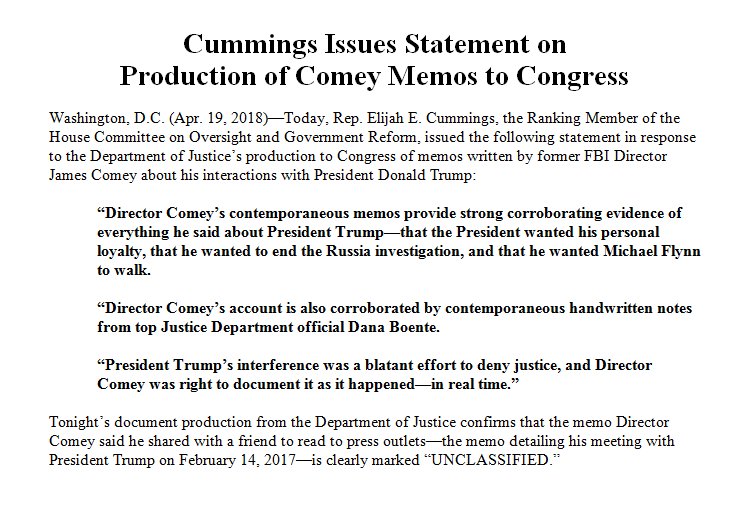
Elijah Cummings Issues Statement on Production of Comey Memos to Congress


Elijah E. Cummings, Ranking Member of the House Committee on Oversight and Government Reform, released the following statement on the release of former FBI Director James Comey's Russia memos to Congress. Cummings believes that the memos corroborate Comey's testimony before Congress.


Thursday, April 19, 2018

HOWARD UNIVERSITY ALUMNUS CHADWICK BOSEMAN TO DELIVER 2018 COMMENCEMENT ADDRESS


Howard University President, Dr. Wayne A. I. Frederick, announced today that actor and alumnus Chadwick Boseman will deliver the keynote address during Howard University’s 150th Commencement Ceremony on Saturday, May 12, 2018.  Mr. Boseman will address members of the Class of 2018 and their families, University trustees, officers, faculty, staff, and alumni.  Howard University will confer upon Mr. Boseman the University's highest honor, an honorary degree, Doctor of Humane Letters.    
“It is an incredible honor and privilege for the Howard University community to welcome back home one of its native sons, Chadwick Boseman, to deliver the 2018 commencement address,” said Howard University President, Dr. Wayne A. I. Frederick. “He has played some of the most iconic African Americans that have transformed history, including Jackie Robinson, James Brown and Howard’s own Thurgood Marshall. His recent role in the blockbuster film “Black Panther” reminds us of the excellence found in the African diaspora and how Howard continues to be a gem that produces the next generation of artist-scholars, humanitarians, scientists, engineers and doctors. Mr. Boseman exemplifies the monumental heights and levels Howard graduates can achieve by using the skills and knowledge they acquired at the university.” 
“I’m excited to return to the Mecca in celebration of the achievements of our illustrious students,” said Boseman. “Let’s listen, learn and build with one another.”
A native of South Carolina, Chadwick Boseman graduated from Howard University and attended the British American Dramatic Academy at Oxford, after which he began his career as an actor, director and writer. Boseman can currently be seen starring as T'Challa/Black Panther in the worldwide phenomenon Marvel Studios' "Black Panther." He made his debut in the Marvel Cinematic Universe as the African superhero in Marvel Studios’ “Captain America: Civil War,” in May 2016. He will reprise the role again for Marvel Studios’ “Avengers: Infinity War” later this month. Boseman's breakout performance came in 2013 when he received rave reviews for his portrayal of the legendary Jackie Robinson in Warner Bros’ “42” opposite Harrison Ford.  Boseman received the 2014 CinemaCon Male Star of Tomorrow Award, was named one of the Top 10 Best Movie Performances of 2014 by Time Magazine and was awarded a Virtuous Award from the Santa Barbara International Film Festival for his portrayal of James Brown in Universal Pictures’ “Get on Up.” 
He previously starred in the title role of Open Road Films’ “Marshall” alongside Josh Gad. The film tells the story of Thurgood Marshall, the first African American Supreme Court Justice, as he battles through one of his career-defining cases as the Chief Counsel to the NAACP. His other feature film credits include: the revenge thriller “Message from the King,” Summit Entertainment's “Draft Day” opposite Kevin Costner, independent psychological post-war drama “The Kill Hole” and Gary Fleders’ drama “The Express.” 
Boseman and his writing partner, Logan Coles, a fellow Howard alum, have written the script for Universal Pictures’ “Expatriate,” an international thriller set around a 1970s plane hijacking. Oscar-winning director Barry Jenkins (Moonlight)has recently signed on to direct the project, in which Boseman will star.
“We are extremely pleased that Chadwick Boseman has accepted our invitation to address the class of 2018,” said Howard University Board of Trustees Chair Stacey J. Mobley, Esq. “His words as one who has walked the same halls as our graduates will truly resonate and inspire them to reach for the stars.”
Howard University’s graduate programs in business, education, engineering and social work increased in the annual national rankings by U.S. News and World Report’s “Best Graduate Schools” listing. The College of Engineering and Architecture increased the to the top 12 percent of engineering colleges in the nation with a No. 132 ranking, a 66-point increase over the past three years. The Howard University School of Social Work ranked No. 30, up eight spots from last year, moving the program within the top 15 percent of programs in the nation. Howard’s School of Business ranked No. 78, following a rank of No. 92 in 2017. The School of Education moved up to number 105, up 15 places from last year’s ranking.